 Hunter Gatherer 21C
Good Morning

Good Morning
Everybody has to start Somewhere.
Social media often suggests success is easy. Rarely. Those first gigs of The Beatles? Poorly attended with mediocre reviews. But, you’ve got to start.
So start.
Overnight success? Takes years.
Be Bold
Go read a book or do a walk or bake a pie or write a poem or clear the leaves or sketch a landscape.
Go Be Human.
Don’t Give Up
It’s noisier than ever out there: social media of course. False everything. Scam this and that. Robots here, there and everywhere. Don’t give up. Do your thing to your best ability. Give meaning be it in coffee, consultancy or your writing. Accept that you might need a cr*p day-job to support you on your path. That’s normal and you can learn a lot waiting tables, filling shelves or up-dating spreadsheets all day.
**Don’t give up. **
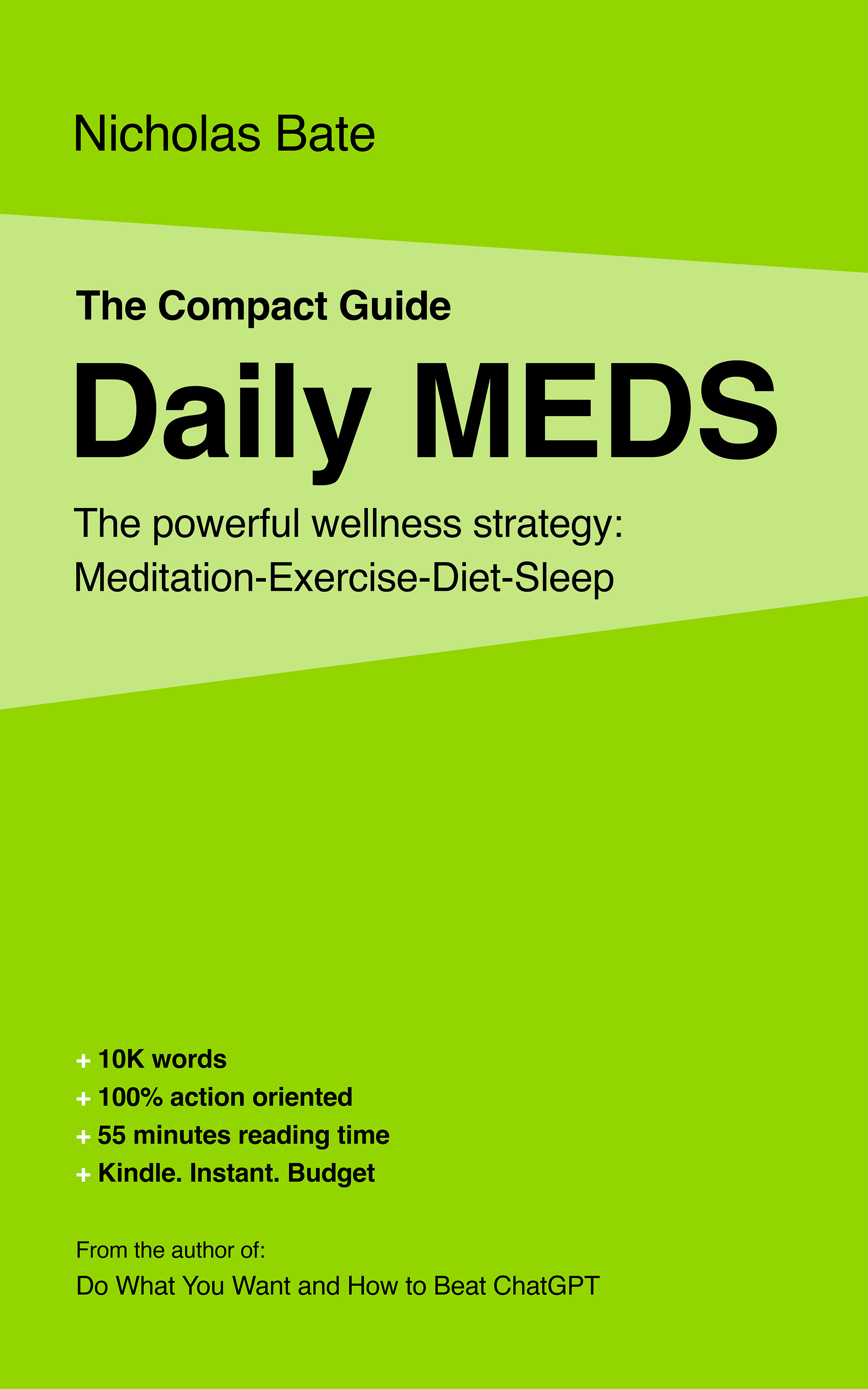
Daily MEDS
The Powerful Wellness Strategy: Meditation-Exercise-Diet-Sleep.
I’m pleased with it. I hope you will find it useful.
How to Beat ChatGPT or How Not to Say AI Killed My Job
Free for a few more hours: kindle, instant, worldwide.
How to Beat ChatGPT or how not to say AI Killed My Job
free amazon kindle. 36h.
Don’t Panic
Artificial intelligence and human intelligence differ not in degree but in kind; they’re different phenomena that happen to share a word: intelligence.
AI excels at pattern recognition across vast datasets. It can analyse millions of medical images, play chess at superhuman levels, and generate coherent text by prediction. But it doesn’t understand what it’s doing. When AI diagnoses cancer, it recognises patterns in pixels without comprehending disease, mortality, or fear. It processes information without experiencing meaning.
Human intelligence, by contrast, is embodied and contextual. We understand because we’ve lived in bodies that feel pain, joy, hunger, and exhaustion. We grasp metaphor because we’ve physically experienced what it means to carry a burden or feel light-hearted. Our intelligence isn’t just computational: it’s somatic, emotional, and social. We learn not just from data but from making mistakes, feeling embarrassed, being surprised and forming relationships.
AI has no stakes in the game. It doesn’t care about its answers, fear being wrong, or hope to be understood. It lacks intentionality, that incredible human capacity to be about something, to direct consciousness toward meaning and purpose.
Perhaps most crucially, human intelligence is creative in a way AI isn’t. We generate novel ideas-and ideas for novels-by combining experiences, emotions, and knowledge in ways we don’t always understand ourselves. We have intuitions, hunches, and insights that emerge from the mysterious depths of consciousness. And by standing at a bus-stop for a delayed No.39.
AI can augment human capability brilliantly.
But. No, don’t panic. But Be Human. Every Minute of Every Day.
Pen & Paper
are still remarkably effective in planning and creating the life you seek.
Books, AI chums and networks will all add support.
But start by putting pen to paper.